Paint sand, water, wood, lava, thermite, uranium and about eighty other things into a box, and they do what those things do. Every material carries its real density, heat capacity, conductivity and melting point, and the whole world runs in metres, seconds and kelvin, as compute shaders on your graphics card. It runs in your browser. There is nothing to install.
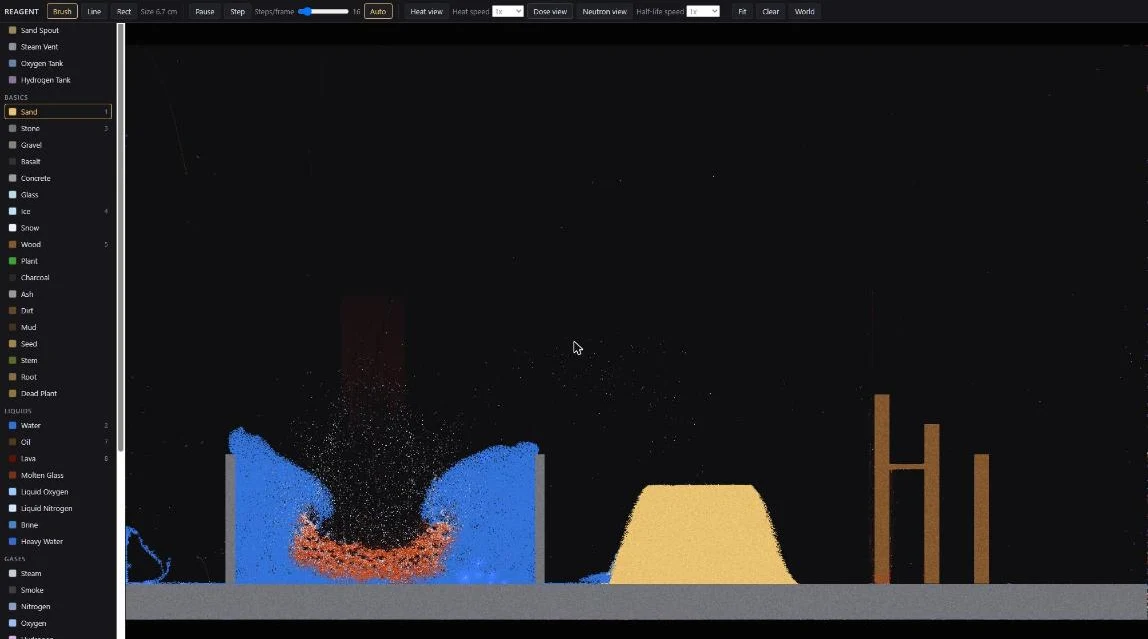
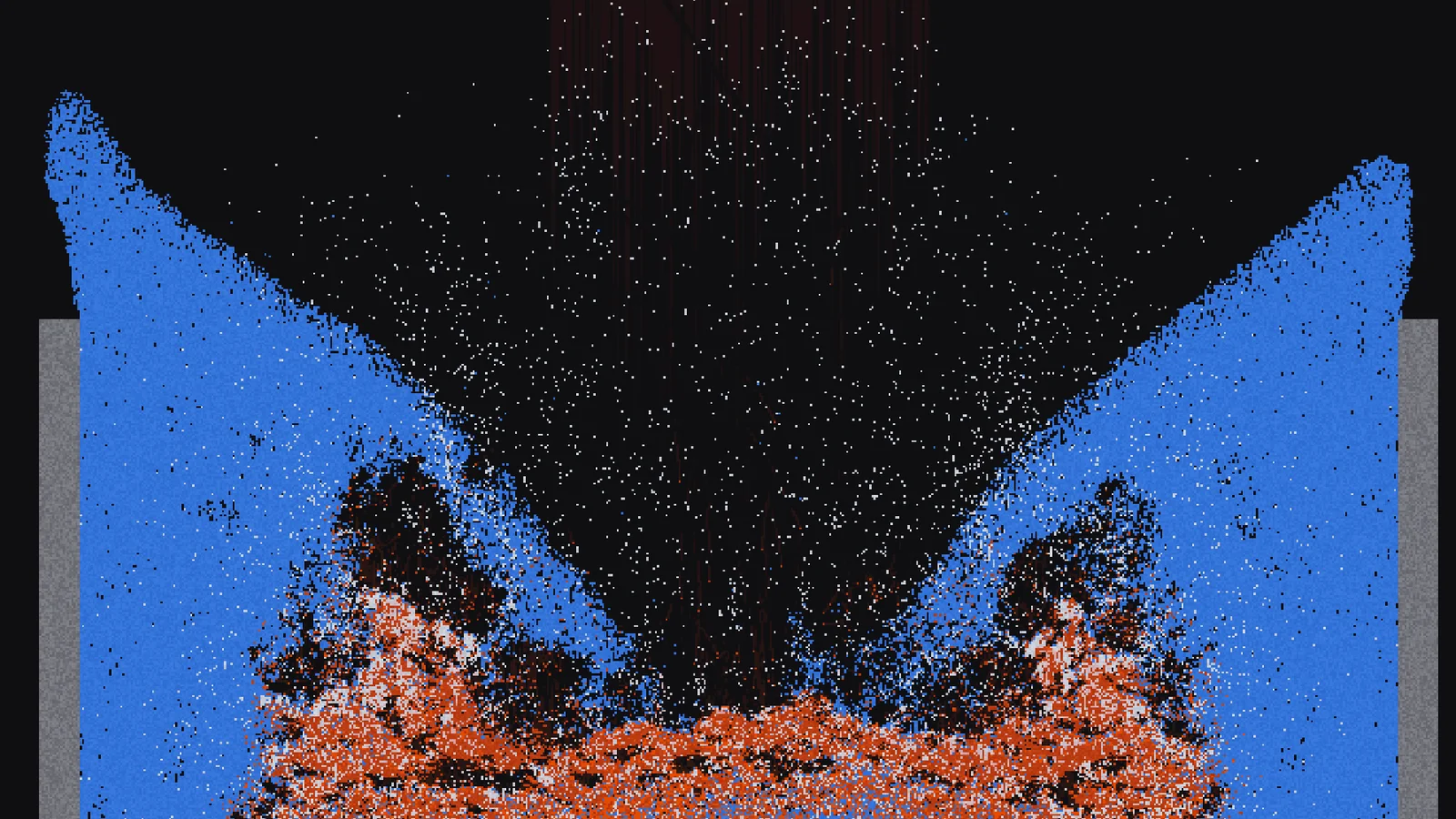
An 8 metre room at 2048 by 1152. Lava has just landed in the tank on the left.
None of these is scripted. There is no "lava meets water" animation anywhere in the code. There is lava at 1,500 K, water that boils at 373 K, and a pressure solve that has to find room for the steam.
The lava turns the water it touches to steam faster than the steam can get out of the way. The tank throws its water up both walls, the lava crusts into basalt on the bottom, and what is left of the pool boils off over the next few seconds.
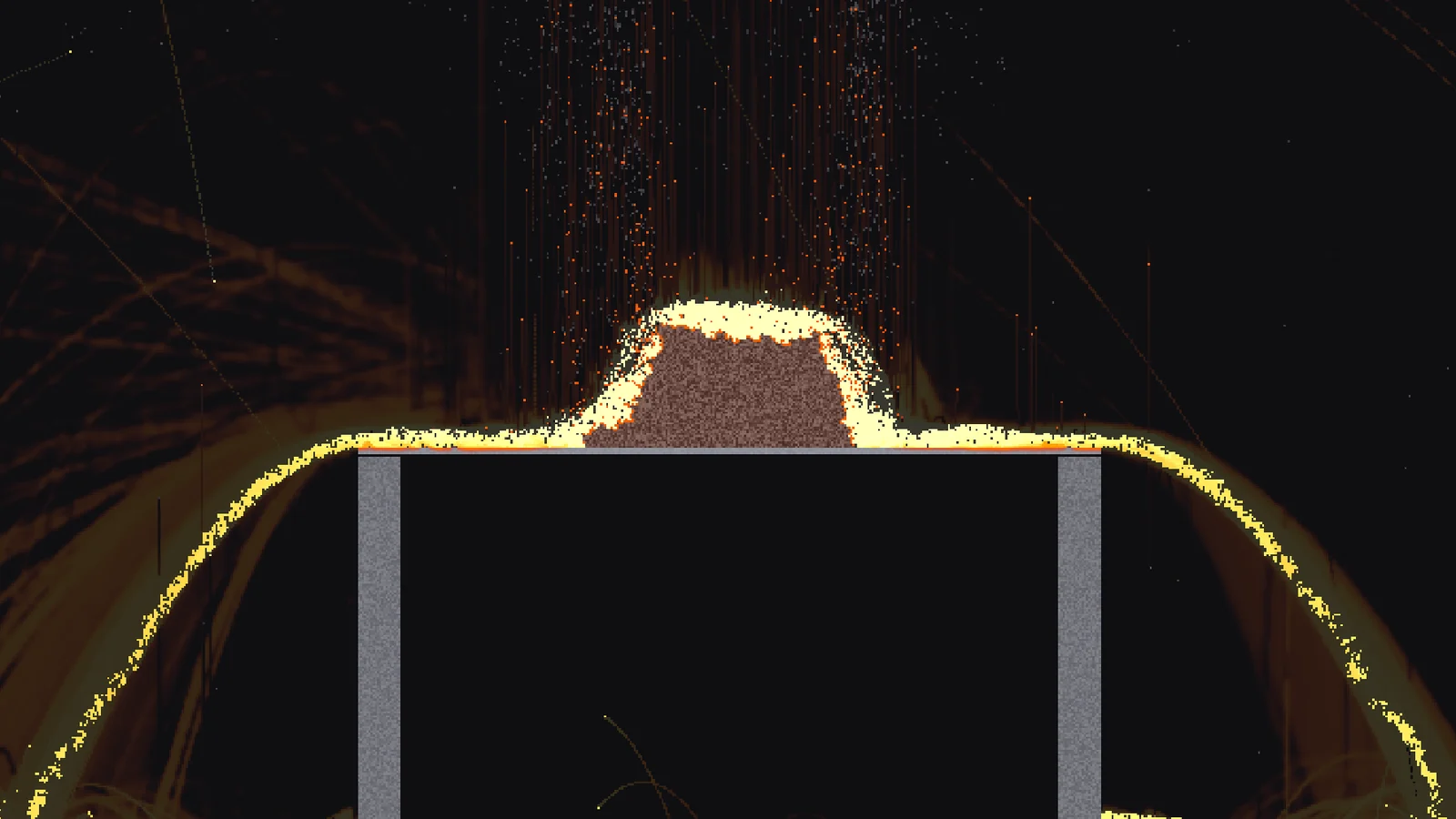
The gunpowder lights at 600 K and lights the thermite at 1,500 K. Thermite burns at 2,800 K into molten iron, which pools on the plate and cuts down through it, throwing burning droplets that trail across the room. A 1.6 cm plate goes. An 8 cm one sits at its melting point and holds, which is what real steel does too.
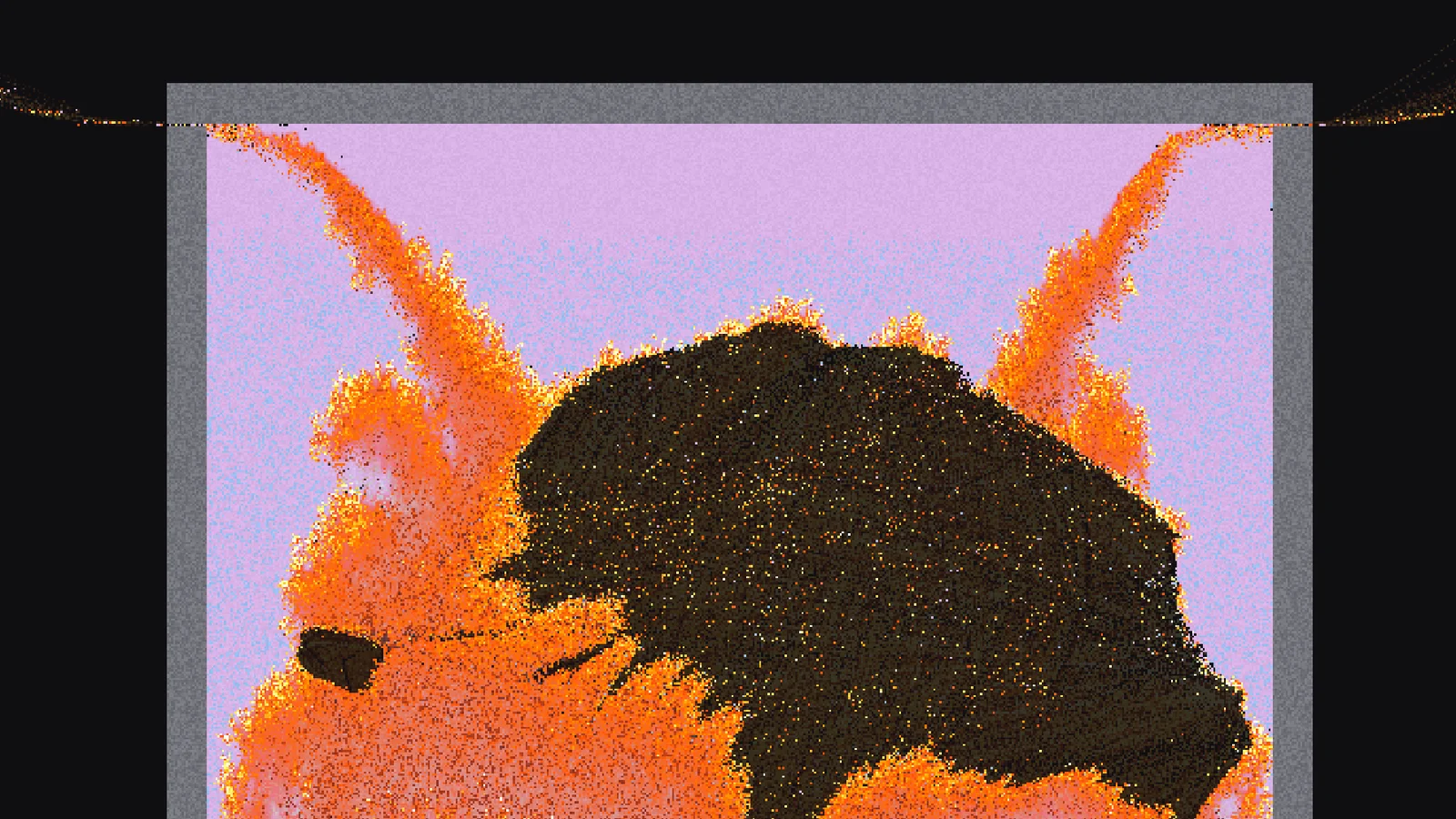
The flame front crosses the box in a fraction of a second at up to 3,500 K and leaves it full of steam. Leave the lid off and it throws whatever is on top.
Water slows neutrons enough for uranium to catch them, so the wet core goes critical where the same rods dry do nothing. With Control Rods between them it holds steady. Without, it runs away, boils its water off and slumps into corium. Neutron view (N) shows the flux, and the water glows Cherenkov blue while it runs.
The air has momentum. The sand drags it down, the smoke tears into eddies around the hole it punches, and the heavy gas rolls away across the floor in waves. Hot air rises the same way: a Heater grows a plume you can see in Heat view.
At 1x the room is real, and real ice takes hours. Sped up, room air rolls over the ice and melts it from the outside in, and the pan dries down a row at a time, sitting a degree below the room as evaporation cools it.
It floats, because sodium is lighter than water, and fizzes itself away into hydrogen and steam. The hydrogen comes off hot enough to catch.
The water boils, the steam rises, meets the cold ceiling, condenses and falls back as rain. Heat view (T) shows the whole cycle in colour.
Radiant heat crosses the gap and the first post catches in a few seconds. The one behind the wall stays cold, because walls cast heat shadows.
Wood burns at about 1,200 K in air. In oxygen it burns four times as fast at about 1,900 K, and uses the oxygen up doing it.
Roots grow down into the soil and stems branch up into leaves. Pour Brine on one end and that end dies back to dead plant, which burns like tinder.
Radium turns to radon gas, which drifts off and decays down the chain to lead. Put a wall in the way: lead cuts the gamma dose about 25-fold, the same thickness of concrete about 3-fold.
A Source becomes whatever touches it first and pours that out forever after. Water makes a spring. Lava makes a volcano. Hydrogen makes a problem.
Every pass is a WebGPU compute shader. The CPU reads the mouse and decides how many steps to run. Everything else happens on the card.
You pick how big the world is and how fine the grid is, separately. Physics follows the size: sand falls a beaker in a fraction of a second and takes its time across a bunker, and a lump of uranium that sits quietly in a beaker can go critical in a room.
Free, in the browser, with nothing to install and nothing to sign up for. The source is private for now.